
Abyssal Garden: The 96 KB Underwater World Claude Code Built From One Prompt
Abyssal Garden is a swimmable 3D underwater world packed into a single 96-97 KB HTML file. Built with Anthropic's Claude Code, it generates kelp forests, a sunken ship, manta rays and synthesized sound procedurally with WebGPU, using no engine or asset files. A built-in AI sub-agent inspects renders for visual defects. Free under the MIT license.
View 4 referencesAllow the functional cookie to save your likes. Privacy details
What Is Abyssal Garden?
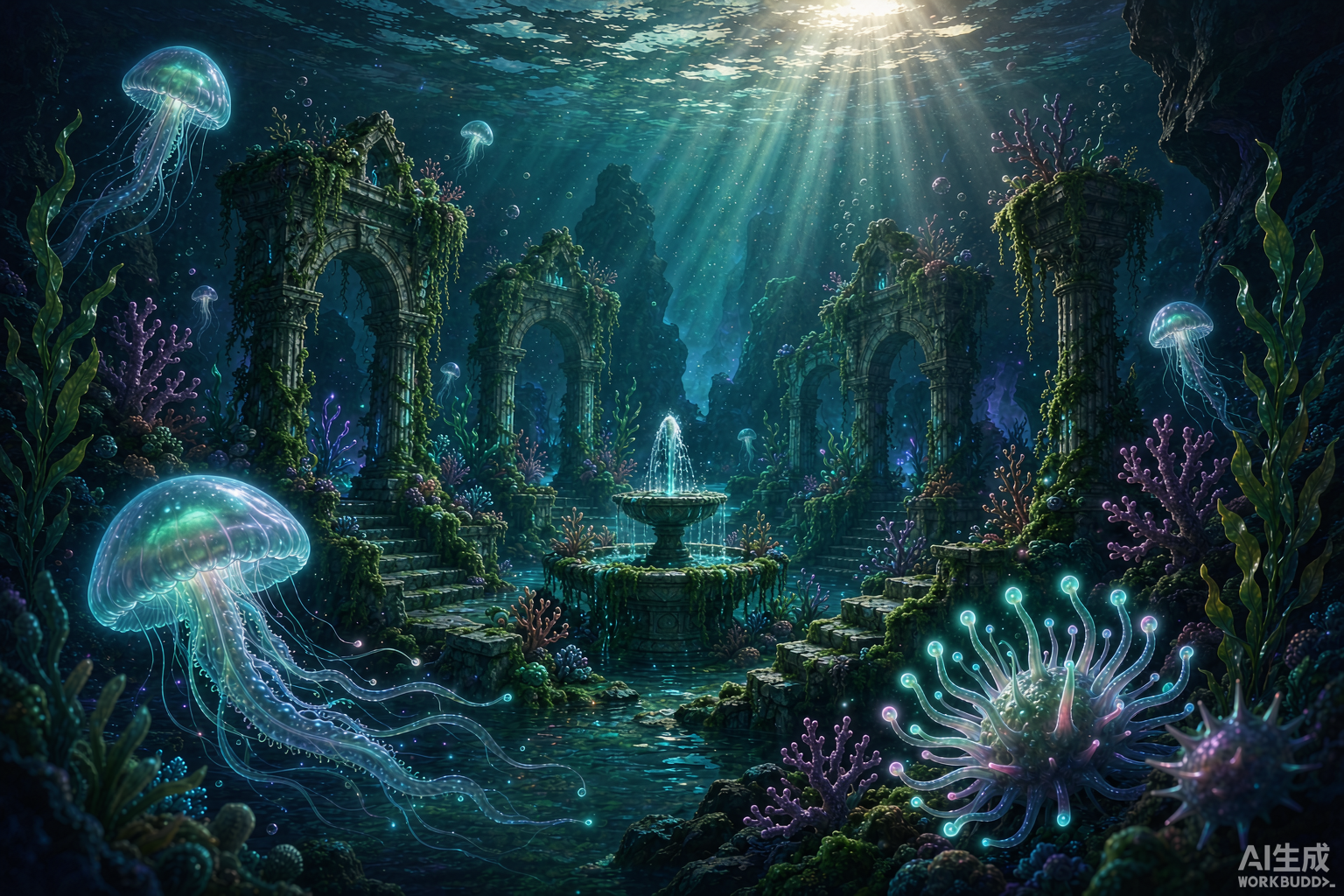
Abyssal Garden is an explorable underwater world that fits inside a single HTML file of roughly 96-97 KB. Open Abyssal Garden in a WebGPU-capable browser, press "Dive in," and you can swim through towering kelp forests, past a sunken wooden ship and a giant stone whale tail, among manta rays and schools of fish, while light rays pour through a rippling surface.
The remarkable part of Abyssal Garden is what is missing. It ships no images, no 3D models, no sound files and no game engine. Instead, the ocean floor is sculpted on the graphics card each time Abyssal Garden loads, then decorated with about two million kelp leaves and plants, tens of thousands of rocks, and thousands of sponges, corals and fish. The soundtrack is synthesized live through the Web Audio API. According to the project's GitHub README and GIGAZINE, every visual in Abyssal Garden is generated by code at load time rather than downloaded as a finished asset.
The result is what some outlets call a single-file demoscene piece: a visually rich 3D environment that loads almost instantly, works offline and needs no installation.
Why Abyssal Garden Went Viral
Abyssal Garden was shared on Reddit by a developer known as Noniv, the same name as the GitHub account that hosts the source. GIGAZINE identifies the creator as Maximilian Dendula. Coverage from Wccftech, GIGAZINE, XDA and others pushed Abyssal Garden into wide circulation in November 2026.
Two things made Abyssal Garden stand out. First, the size: media headlines repeatedly emphasized that an entire swimmable 3D world fits in less than 100 KB, about the size of a small screenshot. Second, the origin story: the developer says the first version of Abyssal Garden came from a single detailed prompt, with the full prompt published as prompt.txt in the repository. That combination of extreme efficiency and AI autonomy made Abyssal Garden a talking point well beyond the usual web graphics crowd.
It is worth being precise about the tools. The coding tool used to build Abyssal Garden was Anthropic's Claude Code, the command-line AI coding agent. Wccftech's headline and several other outlets refer to the underlying model as "Claude Fable 5.2"; the repository itself and the published prompt name Claude Code but do not specify a model version. Treat the model name as a press attribution rather than something stated by the author.
How Abyssal Garden Was Built
The published prompt.txt for Abyssal Garden reads like a specification. It sets priorities in order - visual quality first, stable frame pacing second, small bundle size third - and lists hard constraints: no Three.js, Babylon.js or other engines; WebGPU rendering; everything procedural with no texture or model files; a single self-contained index.html; and zero per-frame JavaScript allocations to avoid garbage-collection stutter.
The target spec in the Abyssal Garden prompt is equally concrete: Windows 11 25H2, Chrome 157, an RTX 5070 Ti, a Ryzen 7800X3D and a 180 Hz monitor, running at 2560 x 1440 with an average GPU frame time of 11 ms or less and no frame over 16.7 ms during a scripted 60-second fly-through.
The Visual Critic Sub-Agent
The most discussed part of the Abyssal Garden prompt is its verification loop. It asks for a "visual critic": a separate AI sub-agent that sees only the rendered output, never the code or the reasoning behind it. This critic is given six fixed camera poses rendered at 2560 x 1440 in GPU-accelerated Chrome, plus a short recording of the fly-through, and is told to catch shimmer, aliasing, popping and banding. It returns prioritized, concrete defects, and the main agent iterates until the critic reports nothing above "minor."
In effect, Abyssal Garden was designed so that the AI checked its own 3D output before declaring the work finished - a concrete example of a visual-acceptance gate baked into a prompt.
GPU Timing and the 60-Second Fly-Through
The second gate in Abyssal Garden is performance. The prompt calls for GPU timestamp queries plus a frame-time log from the scripted fly-through, with the average, 99th percentile and maximum reported. Abyssal Garden is considered done only when both the visual and performance gates pass.
It was not a single pass, however. Wccftech reports that follow-up prompts added collision detection, a start menu and adjustable graphics settings, and the README records a later commit adding a loading bar and dynamic resolution. The developer estimates roughly two to three hours of actual Claude processing, spread over about three days because of subscription usage limits.
What Is Inside the Scene
According to the official README for Abyssal Garden, the world contains:
- Kelp forests that sway and sparkle with gold and green specks, plus shimmering caustics on the sea floor.
- A sunken wooden ship, a giant stone whale tail, rock arches, canyons and floating boulders.
- Manta rays, schools of fish, rising bubbles and drifting particles.
- A purple grotto with glowing magenta ground cover, coral and barrel sponges.
- A soundscape of deep rumbles, distant whale calls, soft chimes and bubbles.
The seabed, cliffs and arches in Abyssal Garden are solid: you glide along the rock rather than swimming through it, and you still fit through every tunnel. Kelp, corals, sponges, loose rocks, the ship and the whale tail can be swum through. The ship, whale tail, mantas, fish and corals are all built from simple mathematical shapes rather than downloaded models.
How to Try Abyssal Garden
To run Abyssal Garden, download index.html from the GitHub repository and open it in Chrome or Edge on a desktop computer. The README says Abyssal Garden also works offline. Wait a few seconds while the world is built, then press "Dive in." A WebGPU-capable browser is required; if you see "This scene needs WebGPU," update your browser or switch to Chrome or Edge.
The controls documented for Abyssal Garden are:
| Action | Input |
|---|---|
| Look around | Move the mouse |
| Swim | W, A, S, D |
| Up / down | E / Q |
| Swim faster | Hold Shift |
| Jump to a viewpoint | 1 to 6 |
| Open menu | Esc |
| Sound on / off | M |
| Performance stats | H |
Touch controls exist in Abyssal Garden but are described as experimental; phones always display the scene in landscape.
Detail Levels
Abyssal Garden offers Low, Medium and High presets. All three show the same world with less content: High is the full scene and is picked on a first visit on computers; Medium uses half the leaves, sparkles and pebbles and drops shadows from small objects, targeting phones with 8 GB of memory; Low uses a quarter of the leaves, disables anti-aliasing, simplifies rocks and lighting and starts at 480p, for other phones and computers with 4 GB of memory or less. Abyssal Garden also scales resolution and draw distance step by step to hold 60 fps, and restarts one level lower if loading crashes the tab.
Performance: What the Numbers Actually Say
The headline figure for Abyssal Garden is about 180 fps at 2560 x 1440 on an RTX 5070 Ti, taken from the README. Wccftech additionally reproduced a capture showing 248 fps on an RTX 4090 at 1440p with the High preset. On the low end, the README reports roughly 20 fps on a Samsung Galaxy A16 at 670 x 372 on Low.
All of these numbers are developer-reported. Wccftech explicitly notes that the Abyssal Garden frame rates have not been independently verified, and actual results depend heavily on hardware, resolution, browser and WebGPU driver maturity.
There is also a small inconsistency in the file size: the README says the whole world fits in 96 KB, while Wccftech, GIGAZINE and the repository description say 97 KB, and GIGAZINE measured the downloaded index.html at 97.1 KB. All figures refer to the single HTML file.
Limitations and FAQ
Abyssal Garden is an interactive graphical demonstration, not a full game. Its sources describe no objective, progression or persistent world. Procedural rendering is also not a new idea; what is unusual is how little code achieves it.
Is Abyssal Garden free? Yes. The project is MIT licensed, meaning you can use, modify and share Abyssal Garden freely, including commercially.
Which AI made Abyssal Garden? The coding tool was Claude Code. Media reports call the model Claude Fable 5.2, but the repository does not confirm a version. The original prompt is public.
Can I modify Abyssal Garden? Yes. The readable source lives in the source folder; with Node.js 18 or newer, run npm install and npm run build to regenerate index.html. Handy starting points include world.js for layout, shaders.js for WGSL visuals and audio.js for sound.
Sources
References
- GitHub - Noniv/abyssal-garden: A dreamy underwater world you can swim through in your browsergithub.com
- Abyssal Garden original build prompt (prompt.txt)github.com
- 'Abyssal Garden' is a free 3D web browser application - GIGAZINEgigazine.net
- Claude Fable 5.2 Creates Stunning Underwater World In Just 97 KB - Wccftechwccftech.com